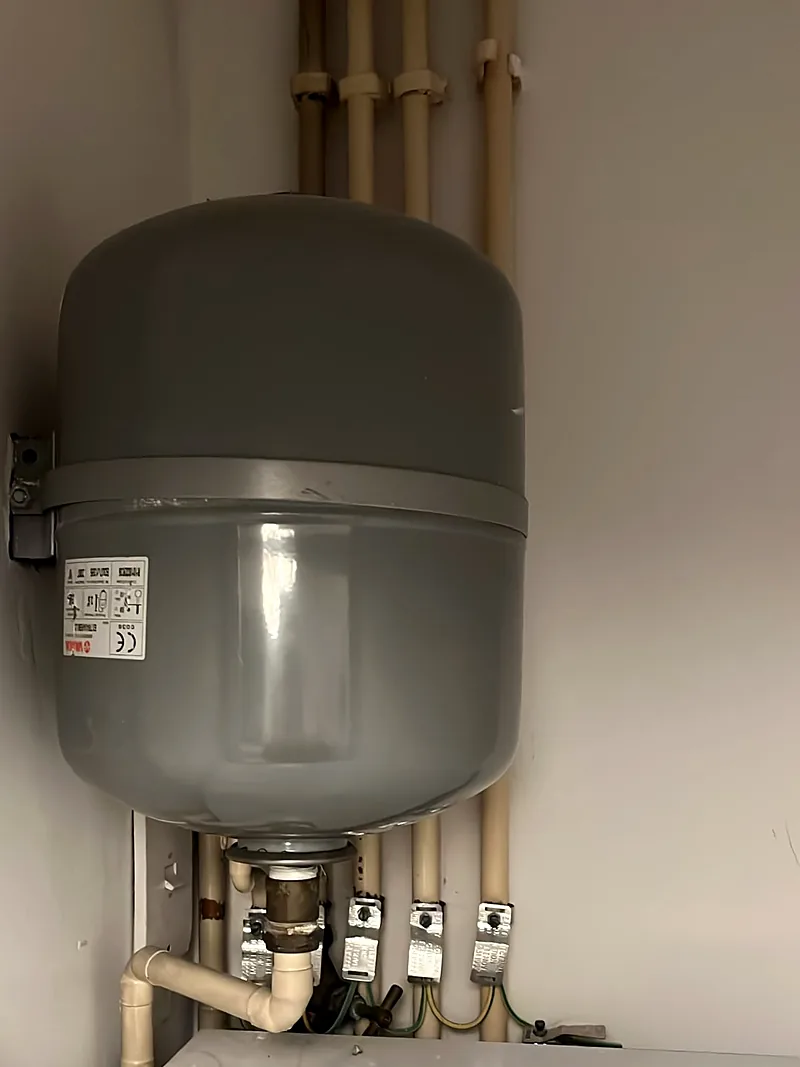
An expansion vessel on its wall bracket in a cupboard, photographed on one of our jobs.
What does an expansion vessel do?
An expansion vessel gives the water in a sealed system room to grow as it heats. Inside it, a rubber diaphragm holds the water on one side and a cushion of air on the other, so the pressure stays steady instead of climbing. London City Plumbers checks that cushion first when a system’s pressure won’t settle.
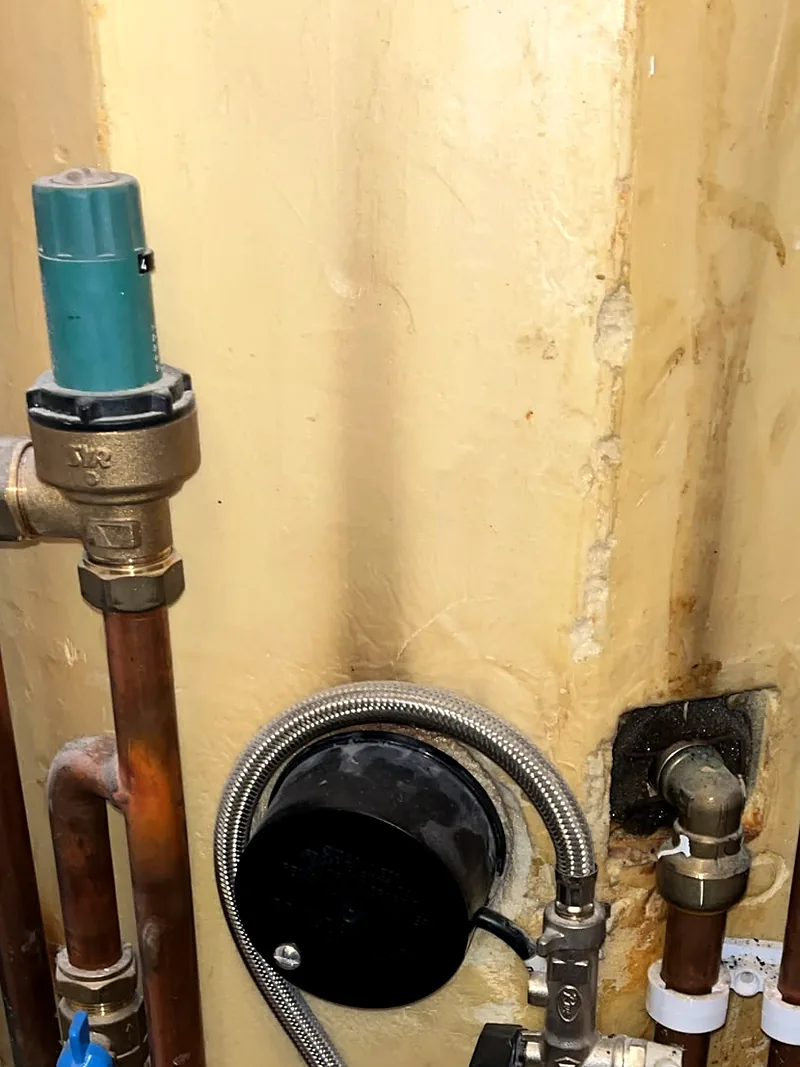
The photograph shows a grey vessel held to the wall by a metal strap, a brass fitting at its base joined to cream painted pipework, and cream pipes with earth bonding clamps behind it.
This post is about what an expansion vessel does, and what we look at when someone rings about the signs below.
The extra water
Water takes up more room as it heats, and the extra has to go somewhere. On an older open system it goes up into a tank in the loft. On a sealed heating system, or a hot water cylinder fed straight off the mains, there is nowhere for it to go, and the expansion vessel is where it goes instead. Inside, a rubber diaphragm keeps the water on one side and a cushion of air on the other. As the water heats, it pushes into the vessel and squeezes the air. As it cools, the air pushes it back out into the pipes. So the pressure stays steady instead of climbing, and that is what an expansion vessel does. Many combi boilers have one inside the casing. A system with a separate boiler or a cylinder often has one on the wall, like this one, and a cylinder fed off the mains has its own separate one for the hot water.
None of that shows on the outside of a vessel.
The signs
A vessel stops doing its job when it loses its air or its diaphragm splits.
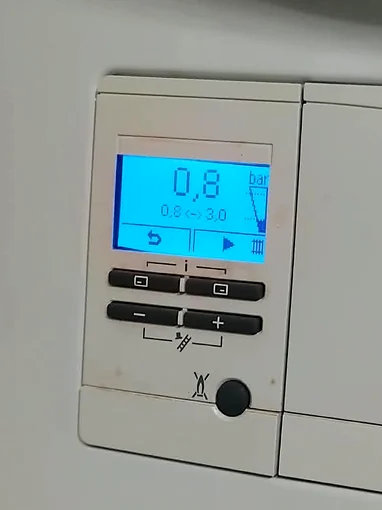
On a heating system, the pressure gauge climbs well up when the heating comes on and drops back when it goes off. Water comes out of the pressure relief pipe outside, and the pressure needs topping up again and again.
On a cylinder fed off the mains, water runs through the tundish, the open gap in the pipe under its safety valves, while the water heats.
Our checks
When someone rings, we look first at whether it is the vessel at all, then whether it has only lost its air or has split.
A split vessel is replaced, not recharged.
A vessel on a cylinder fed off the mains is part of that cylinder’s safety setup, and work on it is for someone qualified in unvented systems.
A new expansion vessel is one of the repairs on our boiler repairs page. The other side of the same gauge, pressure that keeps falling, is in our post on low water pressure.
Ring 07546 185778 and tell us what the gauge reads with the heating off and on, and where any water is coming out.