
15+ years of plumbing and electrical expertise
Trusted by 200+ homeowners across the South East
Boiler Installations in London and Kent
A new boiler is a big decision made in a hurry more often than it should be. The right one depends on the house, the number of bathrooms and what is already on the wall, and the whole job is the flue, the gas run, the flush and the controls as well as the boiler.
Covering Bexley, Dartford, Gravesend, Bromley, Lewisham, Maidstone and Sevenoaks and the rest of our 89 districts.
Call any time, day or night
07546 185778Gas work is carried out by Gas Safe registered engineers we work with. They show you their Gas Safe ID card, and any certificate for the work comes from them.
Google Reviews
4.8198 reviews
Speedy, efficient and nice chap to deal with. We had a leak from above and he was able to see yo and get fixed imminently. We live in Penge and was able to serve the local area
Excellent service from start to finish. We had an emergency situation after 7 pm, and they responded promptly and resolved the issue quickly and professionally. Their efficiency and reliability were greatly appreciated. I would not hesitate to use their services again and highly recommend them to others.
Really quick response time, they came next day. Lovely blokes and got the required work done promptly, very happy with service received. Will definitely use London City Plumbers again!
I would like thank Mr. Ferrell from London City Plumber. Very good and timely advise, really appreciate it. He is very helpful, and guided me with the options available. I would definitely recommend him.
Excellent service. We had a blockage in our main pipe which other plumbers failed to identify. We called Farrell who arrived within an hour the same evening, immediately identified the blockage and removed it, giving us our bathroom back. Highly recommended and will definitely call again for future issues.
Google decides which reviews surface here, not us. Read all 198 on Google
When a new boiler is the answer
Plenty of boilers that stop are worth repairing, and the repairs page is where that conversation starts.
A replacement starts to make sense when the parts for the model are no longer made, when the same boiler has failed three or four times in a couple of winters, when the heat exchanger itself is leaking or corroded, or when the house has changed round it, a loft conversion or an extra bathroom, and the old boiler no longer keeps up. Age on its own is not a reason. Plenty of older boilers run well because somebody looked after them.
Combi, system or regular
Three kinds of gas boiler cover nearly every house we work in.
A combi heats water as you use it, straight off the mains, so there is no hot water cylinder and no tank in the loft. It suits a flat, or a house with one bathroom where two showers rarely run at once. A system boiler runs the heating and keeps a cylinder of stored hot water hot, on a sealed, pressurised system with nothing in the loft. A regular boiler, sometimes called heat only, is the older arrangement: a cylinder, a cold water tank in the loft and a small expansion tank beside it. Which one is right is decided by the house rather than the brochure: how many bathrooms there are, how many people shower at the same time, what the incoming water supply can deliver, and where there is room to put things.
Sizing it for the house
A boiler is sized twice. Once for the heating, by how much heat the house loses on a cold day, and once for the hot water, which on a combi comes down to how many litres a minute it can deliver to a tap or a shower. Bigger is not better. The building regulations say a heating system should not be significantly oversized, and a boiler that is too big for the house tends to switch on and off in short bursts instead of running steadily. The next edition of those regulations, which takes effect in March 2027, goes further: it says a replacement should be sized from a heat loss calculation for the whole house, and not copied from the output of the boiler coming off the wall.
That is a sensible way to work whatever the date.
The day it goes in
Most of a boiler installation is the work around the boiler. The old unit is isolated, drained down and taken off the wall, and the system is flushed before the new one is connected, so years of sludge from the old radiators do not go straight into a new heat exchanger. A filter goes on the return to catch what the flush misses. The gas supply is checked against what the new boiler needs at full output, because a pipe that was big enough for the old boiler can be too small for the new one, which is the subject of one of the jobs written up below. The flue is fitted to the manufacturer’s instructions, through the wall or up through the roof, and the condensate pipe is run to a drain with a fall that will not hold water. Then the controls go on, the system is filled, bled and pressurised, and the boiler is commissioned: lit, checked and set up for the house it is in, rather than left on the settings it came out of the box with. Before anyone leaves, you are shown how it works, where the filling loop is, what the gauge should read and what to do if the display shows a fault.
The gas, the flue and the flush are the job as much as the boiler is.
Controls that come with it
A replacement gas boiler in England has to meet the building regulations, and they cover the controls as well as the boiler. The boiler must reach at least 92% seasonal efficiency. It needs time control, temperature control and an interlock, so it does not fire when nothing is asking for heat. When a boiler is replaced, each room should also have its own thermostatic control, usually a radiator valve, unless there is a sound reason not to. A combi needs one more energy measure from a short list: weather compensation, load compensation, a smart thermostat with automation and optimisation, or flue gas heat recovery.
Which of those suits the house is explained at the visit.
Moving a boiler, and back boilers
Moving a boiler to another wall, a cupboard or the loft is a bigger job than a straight swap, because the gas, the water, the flue and the condensate all move with it, and the new spot has to let the flue out and leave room to service the boiler afterwards. An old back boiler behind a fire in the chimney breast is the biggest change of all. It usually means a new boiler somewhere else in the house, the old one taken out, the chimney made safe and the hot water arrangement rethought from the start.
The quote, in writing
Every installation is quoted after somebody has been to the house and looked, because the right boiler, and the right price, depend on things nobody can see from a phone call. The quote says which boiler, where it goes, the flush and the filter, the gas and flue work, the controls, what happens to the old one, and anything else the house needs, so there is nothing to find out on the day.
Nothing is fitted on a guess.
Recent jobs
Boiler installation jobs we have finished lately, with the photographs from the job.
-
New boiler flue through the wall
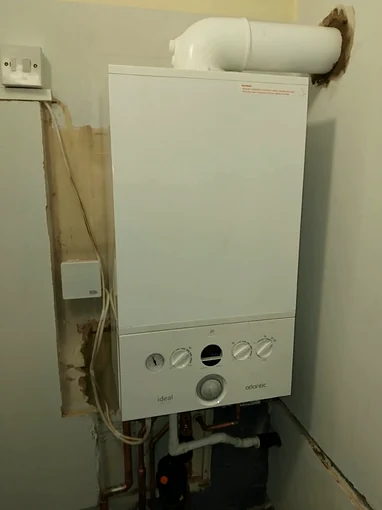
A boiler change, a new Ideal Atlantic 30 combi with its flue running level into the wall beside it. Why a new boiler goes in with a new flue, and the hole. Read about the job -
New boiler gas pipe size
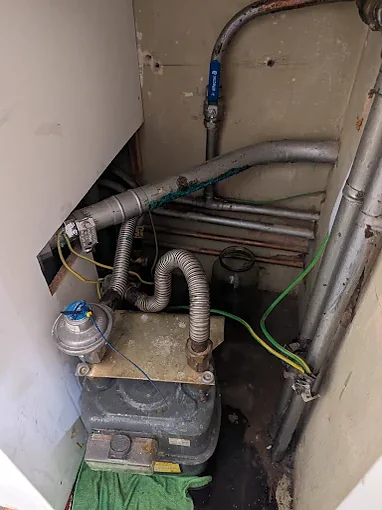
Why the gas pipe is looked at on every boiler change, what decides whether 15mm will do or 22mm is needed, and the cupboard where the run to a boiler starts. Read about the job -
Combi boiler installation, bare wall
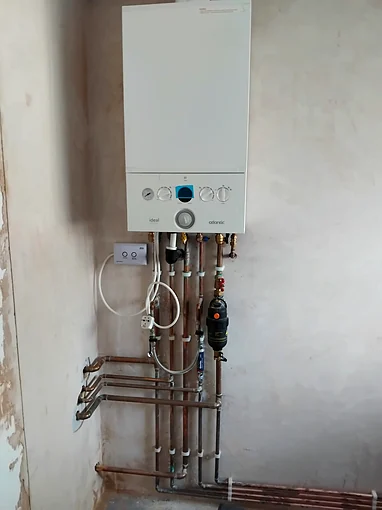
A combi boiler installation photographed mid refurbishment. System filter fitted, isolating valves on, every copper run clipped straight, and why that counts. Read about the job
Boiler installations: common questions
How long does a boiler installation take?
A like-for-like swap in the same place is the quickest kind. Moving the boiler, changing the type of system or taking out a back boiler all take longer, and the quote tells you how long yours will take before anything is booked.
Which make of boiler should I have?
The one that suits the house and whose parts will still be easy to get in ten years' time. We will tell you which one we would choose and why. The jobs on this page include Ideal combis.
Will my radiators need changing?
Not usually for a straight boiler swap. They might if the house has changed round them, if some are too small for the rooms they heat, or if the whole system is being replaced, which is held to tighter rules than a boiler on its own.
Can the tanks in the loft come out?
On a move to a combi or a system boiler, usually yes: the cold water tank and the small expansion tank beside it go. Whether a combi will cope depends on the water supply and on how many bathrooms draw at once, so that is checked first.
Boiler installations across the districts we cover
Eighty nine postcode districts, each with a page of its own. Find yours and you will get the local detail as well as the service.
- DA1 Plumbers & electricians in Dartford Dartford, Crayford and Barnes Cray
- DA2 Plumbers & electricians in Stone, Wilmington & Darenth Dartford (east), Stone and Wilmington
- DA3 Plumbers & electricians in Longfield & Hartley Longfield, Hartley and New Ash Green
- DA4 Plumbers & electricians in Eynsford & Farningham Farningham, Eynsford and South Darenth
- DA5 Plumbers & electricians in Bexley Bexley, Bexley Village and Blendon
- DA6 Plumbers & electricians in Bexleyheath Bexleyheath, Upton and Crook Log
- DA7 Plumbers & electricians in Barnehurst & Bexleyheath North Barnehurst, Crook Log and part of Abbey Wood
- DA8 Plumbers & electricians in Erith Erith, Northumberland Heath and Slade Green
- DA9 Plumbers & electricians in Greenhithe Greenhithe and Stone
- DA10 Plumbers & electricians in Swanscombe & Ebbsfleet Swanscombe and Ebbsfleet
- DA11 Plumbers & electricians in Northfleet & Gravesend West Gravesend (west) and Northfleet
- DA12 Plumbers & electricians in Gravesend Gravesend (east), Chalk and Shorne
- DA13 Plumbers & electricians in Meopham & Southfleet Meopham, Istead Rise and Vigo
- DA14 Plumbers & electricians in Sidcup Sidcup, Foots Cray and North Cray
- DA15 Plumbers & electricians in Blackfen & Lamorbey Sidcup (north), Blackfen and Lamorbey
- DA16 Plumbers & electricians in Welling Welling, Falconwood and East Wickham
- DA17 Plumbers & electricians in Belvedere Belvedere, Upper Belvedere and Lessness Heath
- DA18 Plumbers & electricians in Thamesmead & Erith Marshes Erith Marshes and part of Thamesmead
- BR3 Plumbers & electricians in Beckenham Beckenham, Elmers End and Eden Park
- SE1 Plumbers & electricians in Bermondsey Borough, Bankside and South Bank
- SE10 Plumbers & electricians in Greenwich Greenwich, Maze Hill and Greenwich Peninsula
- SE15 Plumbers & electricians in Peckham Peckham, Nunhead and South Bermondsey
- SE19 Plumbers & electricians in Upper Norwood Upper Norwood, Crystal Palace and Gipsy Hill
- SE2 Plumbers & electricians in Abbey Wood Abbey Wood, West Heath and Crossness
- SE20 Plumbers & electricians in Penge Penge, Anerley and Crystal Palace
- SE26 Plumbers & electricians in Sydenham Sydenham, Upper Sydenham and Lower Sydenham
- SE28 Plumbers & electricians in Thamesmead Thamesmead, West Thamesmead and Southmere
- SE9 Plumbers & electricians in Eltham Eltham, Mottingham and New Eltham
- BR1 Plumbers & electricians in Bromley Bromley, Bickley and Downham
- BR6 Plumbers & electricians in Orpington Orpington, Locksbottom and Farnborough
- SE18 Plumbers & electricians in Woolwich Woolwich, Royal Arsenal and Plumstead
- SE21 Plumbers & electricians in Dulwich Dulwich, Dulwich Village and West Dulwich
- SE22 Plumbers & electricians in East Dulwich East Dulwich and Peckham Rye
- SE23 Plumbers & electricians in Forest Hill Forest Hill, Honor Oak and Perry Vale
- SE25 Plumbers & electricians in South Norwood South Norwood, Selhurst and Woodside
- SE3 Plumbers & electricians in Blackheath Blackheath, Kidbrooke and Westcombe Park
- SE5 Plumbers & electricians in Camberwell Camberwell, Denmark Hill and Peckham
- SW2 Plumbers & electricians in Brixton Brixton, Streatham Hill and Tulse Hill
- SE11 Plumbers & electricians in Kennington Kennington, Oval and Vauxhall
- SE12 Plumbers & electricians in Lee Lee, Grove Park and Chinbrook
- SE13 Plumbers & electricians in Lewisham Lewisham, Hither Green and Ladywell
- SE14 Plumbers & electricians in New Cross New Cross, New Cross Gate and Telegraph Hill
- SE16 Plumbers & electricians in Rotherhithe Rotherhithe, Bermondsey and Surrey Quays
- SE17 Plumbers & electricians in Walworth Walworth, Elephant and Castle and Kennington Park
- SE4 Plumbers & electricians in Brockley Brockley, Crofton Park and Ladywell
- SE6 Plumbers & electricians in Catford Catford, Bellingham and Hither Green
- SE7 Plumbers & electricians in Charlton Charlton, Charlton Village and Westcombe Park
- SE8 Plumbers & electricians in Deptford Deptford, Evelyn and St Johns
- BR2 Plumbers & electricians in Hayes and Keston Hayes, Shortlands and Bromley Common
- BR4 Plumbers & electricians in West Wickham West Wickham and Coney Hall
- BR5 Plumbers & electricians in Petts Wood Petts Wood, St Mary Cray and St Pauls Cray
- BR8 Plumbers & electricians in Swanley Swanley, Hextable and Crockenhill
- CR7 Plumbers & electricians in Thornton Heath Thornton Heath, Norbury and Broad Green
- SE24 Plumbers & electricians in Herne Hill Herne Hill, Tulse Hill and North Dulwich
- SE27 Plumbers & electricians in West Norwood West Norwood, Gipsy Hill and Tulse Hill
- SW16 Plumbers & electricians in Streatham Streatham, Norbury and Streatham Vale
- BR7 Plumbers & electricians in Chislehurst Chislehurst, Elmstead and Chislehurst West
- CR0 Plumbers & electricians in Croydon Croydon, Addiscombe and Broad Green
- ME1 Plumbers & electricians in Rochester Rochester, Borstal and Burham
- ME2 Plumbers & electricians in Strood Strood, Frindsbury and Wainscott
- ME3 Plumbers & electricians in Hoo Peninsula Hoo St Werburgh, Chattenden and Cliffe
- ME4 Plumbers & electricians in Chatham Chatham, Brompton and Luton
- ME5 Plumbers & electricians in Walderslade Walderslade, Lordswood and Blue Bell Hill
- ME6 Plumbers & electricians in Snodland Snodland, Holborough and Ham Hill
- ME7 Plumbers & electricians in Gillingham Gillingham, Brompton and Hempstead
- ME8 Plumbers & electricians in Rainham Rainham, Twydall and Parkwood
- ME9 Plumbers & electricians in Newington and Teynham Newington, Teynham and Iwade
- ME10 Plumbers & electricians in Sittingbourne Sittingbourne, Milton Regis and Murston
- ME11 Plumbers & electricians in Queenborough Queenborough and Rushenden
- ME12 Plumbers & electricians in Sheerness Sheerness, Blue Town and Halfway Houses
- ME13 Plumbers & electricians in Faversham Faversham, Ospringe and Oare
- ME14 Plumbers & electricians in Maidstone Maidstone town centre, Penenden Heath and Sandling
- ME15 Plumbers & electricians in Loose and Tovil Loose, Tovil and Shepway
- ME16 Plumbers & electricians in Barming and Allington Barming, East Barming and Barming Heath
- ME17 Plumbers & electricians in Lenham and Harrietsham Lenham, Lenham Heath and Sandway
- ME18 Plumbers & electricians in Yalding and Wateringbury Yalding, Wateringbury and Mereworth
- ME19 Plumbers & electricians in West Malling West Malling, East Malling and Kings Hill
- ME20 Plumbers & electricians in Aylesford and Larkfield Aylesford, Larkfield and Ditton
- TN14 Plumbers & electricians in Otford and Shoreham Otford, Shoreham and Knockholt
- TN15 Plumbers & electricians in Kemsing and Borough Green Kemsing, Seal and Borough Green
- TN16 Plumbers & electricians in Westerham and Biggin Hill Westerham, Biggin Hill and Tatsfield
- TN13 Plumbers & electricians in Sevenoaks Sevenoaks, Riverhead and Dunton Green
- TN10 Plumbers & electricians in North Tonbridge Tonbridge (north), Higham Wood and Trench Wood
- TN11 Plumbers & electricians in Hildenborough and Hadlow Hildenborough, Hadlow and Penshurst
- TN8 Plumbers & electricians in Edenbridge Edenbridge, Crockham Hill and Marsh Green
- TN9 Plumbers & electricians in Tonbridge Tonbridge town centre, Barden Park and south Tonbridge
- TN4 Plumbers & electricians in Southborough and St John's St John's, Southborough and Rusthall
- TN1 Plumbers & electricians in Tunbridge Wells Royal Tunbridge Wells town centre, St James' and Culverden (part)
- TN2 Plumbers & electricians in Pembury and Sherwood The Pantiles, Sherwood and Pembury
Ring us about a new boiler
Describe the job on the phone and you will get a straight answer about it, then a price in writing before anything starts.
Call any time, day or night
07546 185778