A burst pipe is the call we get most, and it is the one people ring about last.
Not because anyone ignores it. Because a burst pipe under a floor does not look like one. It looks like a damp patch on a ceiling, a skirting board starting to lift, a carpet that is cold in one place, or a boiler that keeps losing pressure. The split is somewhere else. The water has travelled.
Where the water goes
Water under pressure does not drip, it runs.
A pinhole in a copper pipe under the boards will run for days before anything shows, because the water goes down into the void first. It soaks the joists, finds the lowest point, and comes through a ceiling below or up through a floor covering a long way off the pipe. A pipe that has split outright is louder and faster. There is a hiss when the house is quiet, the taps lose pressure, the boiler locks out, and then the ceiling comes down. Either way, the longer it runs the more of the house it reaches. The damage is rarely the pipe. It is everything the water touched on its way to being noticed.
Water off first
Turn the water off. The stopcock is usually under the kitchen sink and closes clockwise. If it is stiff, do not force it, ring us and say so. Catch what is still coming, because a shut stopcock still leaves a pipe full of water to empty, and move anything that will spoil. If water has reached a socket, a light fitting or the fuse board, say that when you ring. We carry both trades, and it changes what we bring.
Finding the split
Where the water shows is the start of the search, not the end of it.
First we work out which pipe it is, because that decides everything else: cold mains, hot, or heating. With the stopcock off, a cold mains leak stops. A hot leak carries on until the cylinder or the combi has run down. A heating leak shows on the boiler’s pressure gauge, dropping again every time it has been topped up. Then we isolate sections at the valves under sinks and behind appliances, and watch what changes. Then we open the floor, and we open it in one place rather than six, because the point of the work before it is to know where to cut. Under the boards we look for where the water is coming out, not only where it is wet, because a run drips off its lowest joint and the split can be a metre uphill of the puddle. When there is no way to see it, the pipe gets pressure tested a section at a time until the one that will not hold is found. That is slower than guessing, and it is the only way that ends with one hole in the floor.
New pipe, not a patch
A repair clip on a split pipe is for tonight, not for next winter.
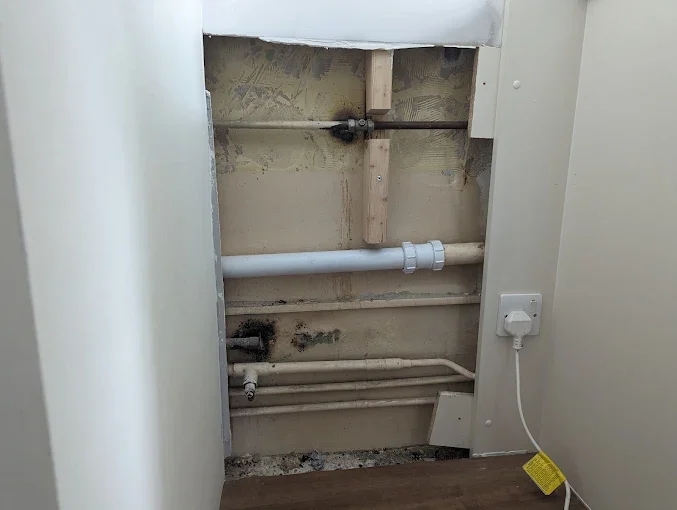
The fix is to cut the damaged section out and fit new pipe, and to look hard at the run either side of it, because a pipe that has failed in one place is usually telling you about the whole length. Old copper gone thin. A joint that was never right. A run left unclipped that has been knocking for years. The photograph is a cupboard stripped back to the bare wall so the pipework could be got at, with the old run exposed and a new run fitted across it, which is what most of these jobs look like halfway through. Then the floor goes back down, the cupboard goes back together, and the water goes on and stays on.
Ring us
Ring 07546 185778 and tell us what you can see, whether you have got the water off, and whether it has reached anything electrical. Our emergency page says what counts as an emergency and what to do while you wait, and a burst pipe is at the top of that list. If it turns out to be a waste run rather than supply, that is pipework, and it is the same van.