A wet patch on the ceiling is the whole of what the people downstairs can see.
The fault is upstairs, in a flat they cannot get into, and nobody knows yet what it is. That is the shape of every one of these calls. Two homes, one leak, and the water is in the home where the problem is not.
Where the water shows
Water comes through a ceiling a long way off where it left the pipe. It runs along a joist, sits on the plasterboard until the board can hold no more, and comes through at the lowest point or at a light fitting, because that is where there is already a hole. So the wet patch in the flat below is a clue, not a location. Our emergency page lists a leak nobody can find the source of as one of the calls that come in most, and water coming through a ceiling as the kind that cannot wait for the morning.
Two flats, one leak
The people downstairs have the water. The people upstairs have the fault. Neither can sort it without the other.
Downstairs, catch what is coming and move what will spoil. If the water is coming through a light fitting, say so when you ring. Upstairs, if anyone is in, the stopcock for that flat is usually in the airing cupboard or a service cupboard on the landing, and turning it off stops most leaks getting worse while you wait. If nobody is in upstairs, ring us anyway. A leak does not stop for being unattended, and knowing that is the situation changes what we do first.
The usual causes
Most leaks between flats are small things in wet rooms, and most of them are not where anyone expects.
A bath or shower waste that has let go under the bath panel, so every shower sends a cupful down onto the ceiling below. A basin waste or a sink waste with a joint that has crept. A washing machine hose or a flexible tap connector that has failed where it bends. A toilet pan connector that weeps when it is flushed and nowhere else. A radiator valve that drips only when the heating is on. And the most common of the lot, which is not a plumbing fault at all: the seal round a bath or a shower tray, where the water goes down behind the tiles every time someone showers and the plumbing is perfectly sound. So we start in the room above the wet patch and we run things one at a time. The bath, then the basin, then the shower, then a flush, with someone below watching the patch. We isolate what we can, we pull the bath panel, we get a torch under there, and we only cut into a ceiling when there is no other way of seeing. Once the cause is found the fix is usually small, and the drying out is the bigger job.
Waste runs and access
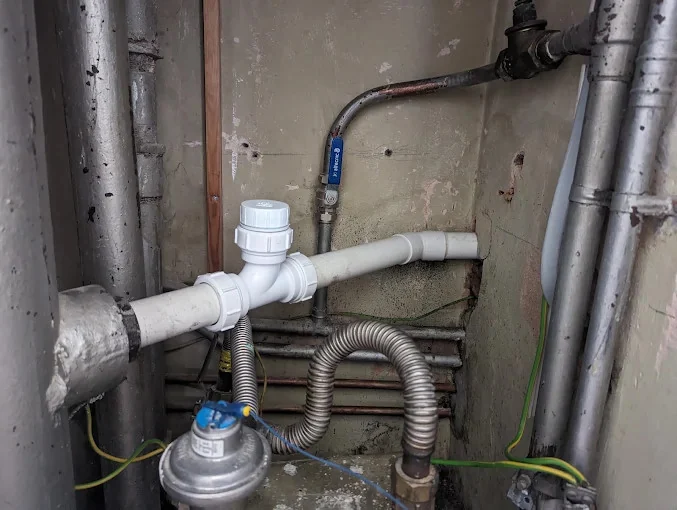
The photograph is a service cupboard with a new waste run across the back of it.
When a waste run has failed or blocked badly enough to be sending water where it should not go, the fix is new pipe, run with a proper fall, and we put an access cap on it so it can be cleared next time without the cupboard coming apart again. In a block, next time comes. That work is drainage and pipework, and it is the same van.
Before you ring
Ring 07546 185778 and say which flat you are in, what you can see, and whether anyone is in upstairs. The emergency page says what else helps when you call. If the water has come through a light fitting, the electrics below it are part of the job, and because the van carries both trades that gets looked at on the same visit as the pipe.