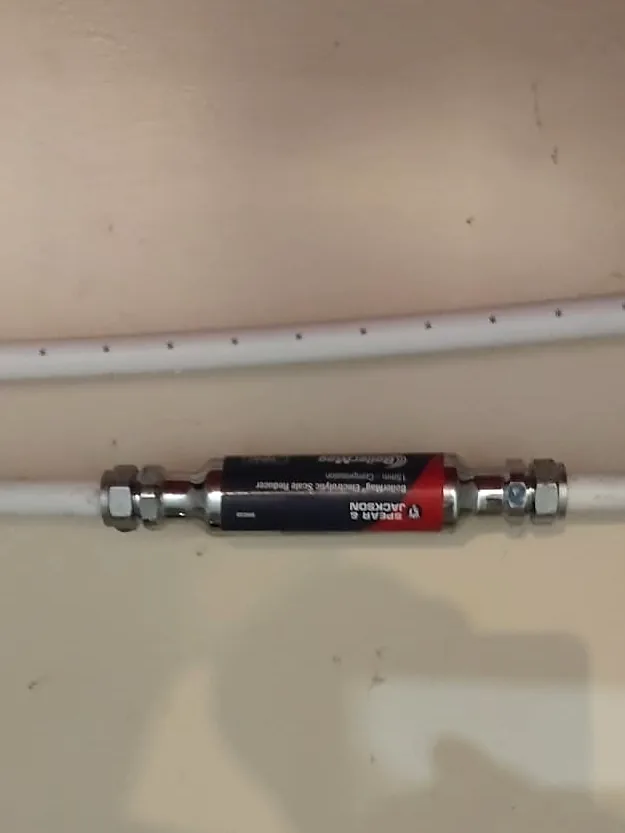
A scale reducer fitted in line on a pipe.
What does a scale reducer do?
A scale reducer sits in line on a cold water pipe and changes the way the chalk in hard water comes out when the water is heated, so it forms a soft powder that washes through instead of a hard crust on heat exchangers, elements and valves. London City Plumbers fits them with a compression joint at each end.
The photograph shows it in place: a short chrome and black body joined into a white plastic pipe, a compression nut at each end, on a cream painted wall with a second white pipe running above it.
Hard water
The ground under most of our patch is chalk, so the water is hard.
Our boiler repairs page covers what that does: over years, the scale settles in heat exchangers, on immersion elements and inside shower valves.
Two of those have posts of their own here, an immersion heater element not working and a concealed shower valve replacement.
Inside a scale reducer
A scale reducer, which people also search for as a scale inhibitor or a limescale inhibitor, is a short metal body fitted in line on a cold water pipe, so the water passes through it before it reaches whatever it protects. The common inline kind is the electrolytic scale reducer. Inside the body is a core of a different metal, and as the water passes, a tiny trace of that metal goes into the water. That trace changes the way the chalk comes out of the water when it is heated. Instead of a hard crust that sticks, it forms a soft powder that washes through. It needs no power, no salt and no chemicals, so there is nothing to plug in and nothing to top up. All it asks for is room on the pipe for the body and a compression joint at each end, like the two in the photograph. The core is used up slowly, so in time the reducer is replaced rather than serviced.
Softeners and magnetic filters
A scale reducer is not a water softener.
The water is still hard when you drink it, and it will still fur a kettle in time. What changes is that the scale does not build up as readily on the hot surfaces behind it.
A magnetic filter is a different thing again. That sits on the heating pipework and catches iron sludge out of the radiators. A scale reducer sits on the cold water side and is about chalk.
The pipe run
On this kind of call we look at where the cold water enters and what it feeds.
Then we pick a straight run of pipe with room for the body and its two joints, fit the reducer, and check both joints for weeps once the water is back on.
Ring 07546 185778 and tell us whether the kettle furs quickly, the shower head blocks up, the hot water has gone slow or the heating is noisy.