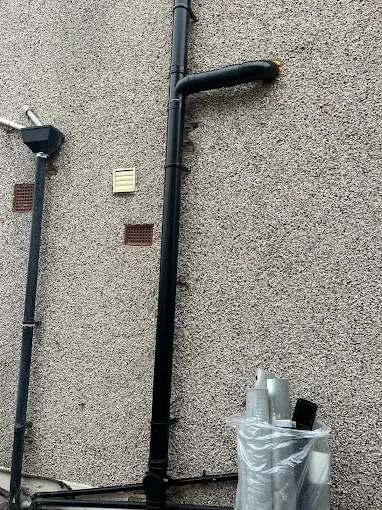
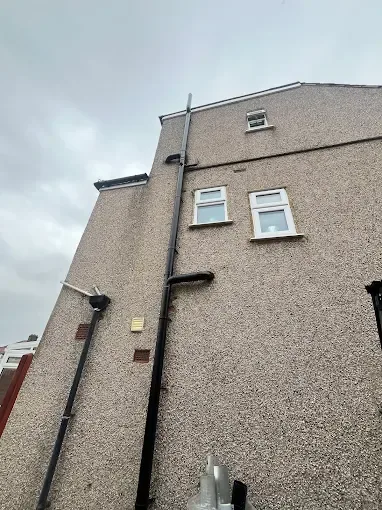
The first photograph is taken at the bottom of the ladder, looking up.
The black pipe running the full height of the gable is a new soil stack, the vent above the eaves down to the ground. The second is the lower part of a run on the same sort of wall, where the swept bend and the branch come in at the top and the brackets go into the render. Between them they show the two ends of the job: the height, and the fiddly bit at the bottom where everything has to line up.
Why replace rather than patch
A soil stack takes everything a house sends down it, and it does it outside, in the weather, for decades. When one starts to go it rarely goes all at once. A joint drops. A bracket rusts through and the pipe moves. A crack opens up behind the stack where nobody can see it. What the customer sees is a damp patch on an inside wall, sometimes for months, before anyone connects it to the pipe outside. If it is coming back up indoors instead, that is an emergency rather than a job for the morning. Patching one joint on a stack like that buys a season. The next joint is the same age and it has been through the same winters. So when we are already up there with the ladders and the brackets, replacing the run is nearly always the honest answer, and it is the one we gave here.
Brackets and falls
Before anything is fixed, the run is set out.
That means deciding where every bracket goes so the pipe is held at the right spacing all the way down, and it means getting the falls right on the branches so waste runs the way it should rather than sitting in the pipe. The bends are swept rather than sharp, which you can see in the second photograph, because a sharp bend on a soil pipe is where things catch and a swept one lets everything through. The brackets are the cast type, fixed into the render, and there are more of them than you might expect, because a stack that is not held along its length ends up hanging its weight off its own joints, and that is how the joints open up again. The branches are made up so the runs stay true, and the connections into the stack are sealed rather than pushed in and hoped for. Then the whole thing is tested rather than eyeballed, because the top of a three storey stack is not somewhere you want to go back to next week. None of it is glamorous. It is a day of ladders, drilling into pebbledash, and making sure the pipe you are leaving behind will be there, doing its job, long after you have gone.
Three storeys
The height is the part that puts people off, and it is the reason these jobs get left. The stack in the first photograph runs past three floors of windows to the vent above the roofline. Working at that height takes the right access and the time to set it up, and that is part of the job rather than an extra. Full height stack work on a three storey property is part of the ordinary run of jobs for us, and the photographs are here so you can see that rather than take our word for it.
If yours is leaking, moving, or you have a damp patch nobody can explain, ring 07546 185778 and describe it. You will get a straight answer about whether it is a patch or a replacement, in writing, before anything starts.