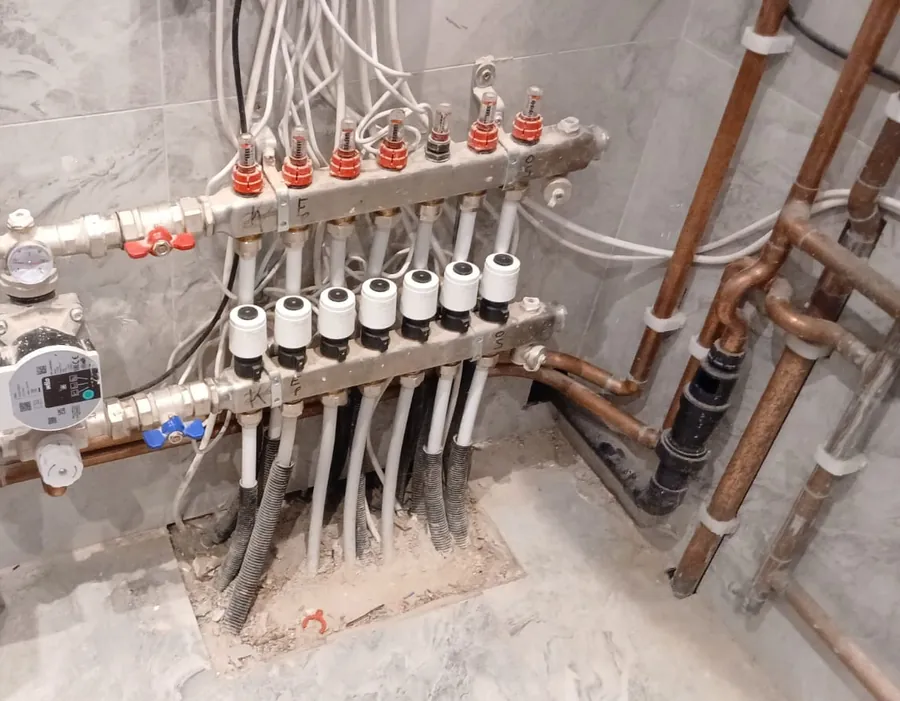
An underfloor heating manifold in the corner of a tiled room, with the pump and the blending valve on the left.
What does an underfloor heating manifold do?
It splits the heating water into the separate loops of pipe under the floor and collects it again. One bar sends the water out to each loop, the other takes it back, and the pump and blending valve beside them keep it moving at a lower temperature than a radiator runs at.
The photograph shows the whole of it. Two steel bars run along the wall. The upper one carries a row of flow gauges with red caps, and the lower one a row of white actuator heads. White pipes drop out of both into black sleeves and down into the floor, where the screed is open round them, and copper pipes come in on the right.
How the manifold works
Wet underfloor heating is long loops of pipe laid in the floor, one or more to a room, all starting and finishing at the manifold. Heating water arrives at one end. The pump keeps it moving, and the blending valve beside the pump, with its temperature gauge on top, mixes cooler water back in so the water going into the floor stays well below what a radiator runs at. A floor is a big, slow heater, and a floor run too hot is uncomfortable to stand on and hard on the screed and the finish above it. The water goes along one bar and out into each loop, round the room under the floor, back into the other bar, and then on its way to be heated again. Each loop has its own flow gauge and its own actuator, so each room can be balanced and switched by itself. The red and blue lever valves at the end shut the manifold off, so it can be worked on without draining the rest of the heating.
That is an underfloor heating manifold, often written UFH manifold, and the pump and valve together are often called the pump pack.
The gauges and the heads
The flow gauges with red caps show how much water goes through each loop.
A long loop needs more flow than a short one to give the same warmth, so the gauges are set to share it out. That is balancing.
The white heads are actuators. Each one is wired to a room thermostat, and the white cables running up the wall above the manifold are their wires. When a room is warm enough, its actuator shuts that loop.
The pipes in the floor
The loops come up out of the screed in black sleeves, which stop the pipe kinking where it bends up into the bar.
The job
An underfloor heating manifold does its work out of sight, and the floor only stays even when every loop gets its share.
We wrote up what an expansion vessel does and a wireless room thermostat before, and our boiler repair page covers the rest of the heating.
Ring 07546 185778 and say what your underfloor heating is doing, and send a photograph of the manifold if you can.